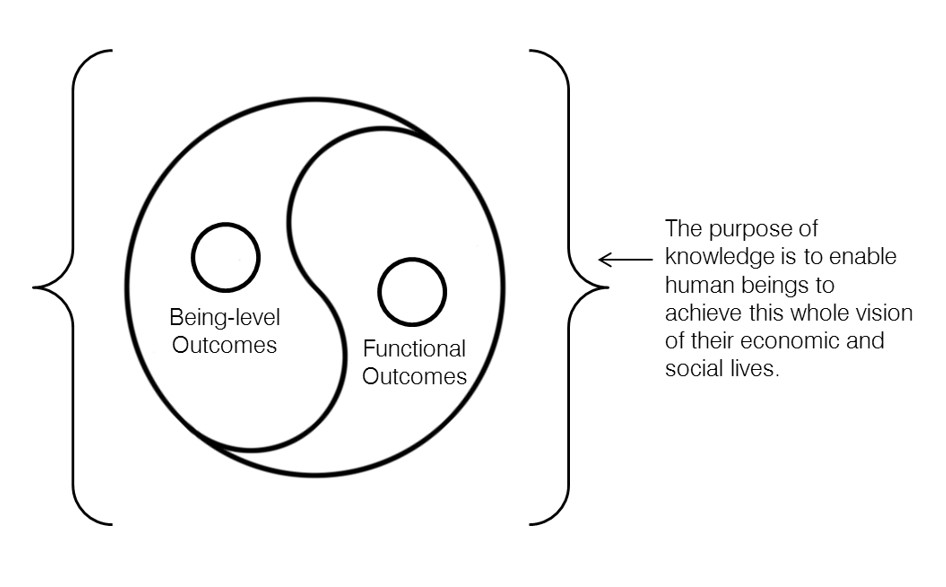
‘Knowledge for Enablement’ represents a point of view. It is an answer to the question, “what is the purpose of knowledge in a knowledge society?”
Is the purpose of knowledge to be the critical “factor of production”? i.e., is a knowledge society differentiated from, say an agrarian or a manufacturing society, because the creation, conversion, distribution, and delivery of knowledge creates so much economic value?
Is the purpose of knowledge to provide human beings with the necessary capacities to participate effectively in a technologically advanced society? i.e., as society advances in technology – the threshold level of knowledge and education needed to survive and thrive is much higher than ever before.
Is the purpose of knowledge to provide human beings with the skills and capacities necessary to choose and act in an increasingly complex world? i.e., as society becomes complex, interdependent, and fast-changing, human beings need greater skills to
(i) sift through the diverse inputs that come from multiple sources,
(ii) add meaning to information,
(iii) clarify and think through these choices.
Or is there a purpose of knowledge that includes all these, but in a more fundamental way goes beyond these purposes?
To appreciate this, let us go back to the three purposes we have already outlined:
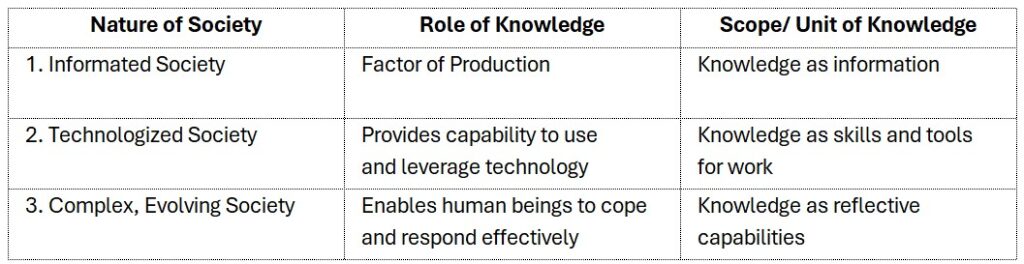
All three viewpoints are valid and mutually complementary – and indeed there is much literature which elaborates one or more of these viewpoints.
This essay, however, proposes a fourth point of view that recognizes and accepts all of the above but seeks to add a new dimension to our understanding of knowledge and its role in contemporary society.
In this essay, we ask the questions “can knowledge be used to transform the quality of human thought and endeavor”? Can knowledge be used as a method for enhancing meaning, purpose, and fulfillment for human beings? Can knowledge be used to transform the quality (not speed and connectivity) of inter-human relationships? Can knowledge be used to help individuals discover a far greater potential within themselves and unleash this potential such that their own lives and the lives of those around them is transformed?
What is the distinction between the purposes of knowledge described in the table above and the purposes of knowledge described later?
The distinction can be understood when we categorize human purposes into two sets:
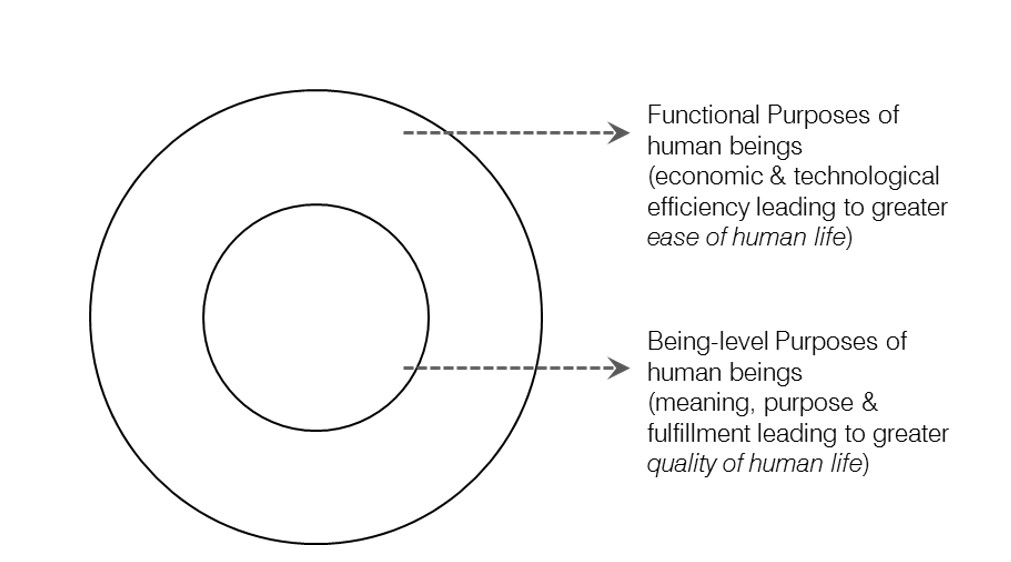
Forms of knowledge that achieve functional purposes include information, skills, worktools, thinking and decision-making methods, etc.
Forms of knowledge that achieve being-level purposes include meaning-making capacities, clarity of purpose, pathways to personal fulfillment, capacity to improve human relationships, etc.
These two sets of purposes – functional and being-level – while distinct in concept, are deeply intertwined in practice. As an example: we enjoy (being level) what we are good at (function level), and we become good at what we enjoy.
When these two purposes are integrated and mutually supportive, human life becomes rich, meaningful, full of possibilities and potentialities – where economic and social success are happy side effects.
When these two purposes are treated as distinct – then we face a society where economic outcomes and ease of life (physical and technological), may not be accompanied by a concomitant increase in individual outcomes and quality of life.
Put harshly, we may live in an alienation between our inner/ personal lives, and our outer/ economic lives.
In this essay we posit a new point of view – the goal of knowledge is to help human beings achieve both their functional and being-level purposes – not independent of each other – but as mutually reinforcing and supporting aspects of a single whole. This goal we call “Knowledge for Enablement”.